
How Battery-Free Technology Works

Understanding the mechanics behind battery-free locking solutions reveals why this technology is rapidly replacing traditional battery-powered systems. At its core, battery-free technology relies on energy harvesting—the process of capturing small amounts of ambient energy from the surrounding environment and converting it into usable electrical power.
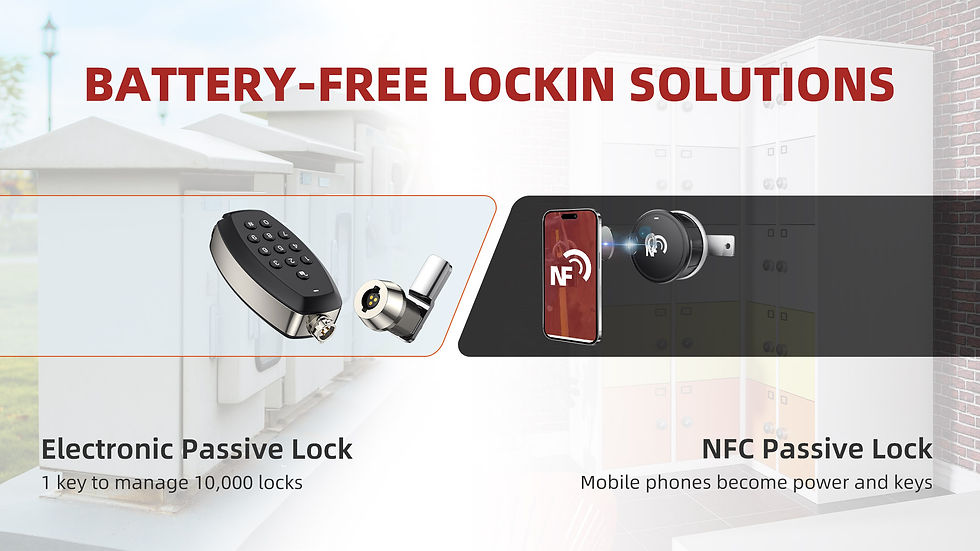
The Two Pillars of Battery-Free Locking
Battery-free locks typically employ one of two energy-harvesting methods, though hybrid systems are emerging:
1. NFC Energy Harvesting
Near Field Communication (NFC) energy harvesting is the most common approach in consumer and commercial smart locker applications. Here is how it works step by step:
Step 1: Field Generation When a user brings an NFC-enabled smartphone or card within approximately 4 cm of the lock's antenna, the device generates a 13.56 MHz electromagnetic field. This field carries both data and energy.
Step 2: Inductive Coupling The lock contains a copper coil antenna tuned to the same 13.56 MHz frequency. As the electromagnetic field passes through this coil, it induces an alternating current via electromagnetic induction—essentially the same principle that powers wireless phone chargers, but on a much smaller scale.
Step 3: Rectification & Storage The alternating current from the coil passes through a rectifier circuit that converts AC to DC. This low-voltage DC power charges a small capacitor or supercapacitor (typically 10–100 µF) within milliseconds. Modern NFC harvesting chips, such as those from Infineon or NXP, can extract 20–50 mW of power—more than enough to power a microcontroller and actuator.
Step 4: Authentication & Execution Once the capacitor stores sufficient charge (usually within 200–500 ms), the onboard microcontroller wakes from its zero-power sleep state. It reads the credential data from the NFC signal, verifies it against encrypted keys stored in ROM, and if valid, activates a solenoid or motor to retract the locking bolt. The entire unlock sequence completes in under one second.
Step 5: Power Dissipation After the lock state changes, the capacitor discharges completely. The microcontroller returns to sleep, and the system returns to a completely passive state—consuming zero standby power until the next NFC interaction.
Technical Note: Because the lock has no battery to maintain a clock, time-based access permissions are typically managed server-side. The NFC credential itself carries a time-stamped token signed with a private key, preventing replay attacks.
2. Kinetic Energy Harvesting
Kinetic or mechanical energy harvesting is predominant in industrial passive lock systems where NFC infrastructure is unavailable or unreliable. This approach converts physical motion into electricity:
Step 1: Mechanical Input The user inserts an electronic key into the lock cylinder and turns it. This mechanical rotation drives an internal micro-generator.
Step 2: Electromagnetic Generation Inside the lock, the turning motion spins a small permanent magnet past fixed copper windings (or vice versa). According to Faraday's law of electromagnetic induction, this relative motion between magnetic field and conductor generates an electrical pulse. A typical turn produces 5–15 mJ of energy.
Step 3: Power Conditioning The raw pulse passes through a voltage regulator and rectifier to produce stable DC voltage (usually 1.8V or 3.3V) suitable for digital electronics.
Step 4: Mutual Authentication Unlike simple mechanical locks, the electronic key and lock engage in a challenge-response protocol. The lock generates a random nonce, the key signs it with its embedded cryptographic chip, and the lock verifies the signature before releasing the mechanism. Without valid authentication, the mechanical energy simply dissipates—turning the key does nothing.
Step 5: Data Logging Advanced systems write an access record to non-volatile memory (EEPROM or FRAM) within the key itself. When the key later connects to a management station, all access logs upload to the central system, creating a complete audit trail without any network connectivity at the lock point. Battery-free locks do not exist in isolation. They integrate with cloud or local management platforms through:
NFC Smartphones as Bridges: The phone reads the lock's status (if equipped with bidirectional NFC) and relays it to the cloud via cellular or Wi-Fi.
Electronic Keys as Data Couriers: In kinetic systems, the key physically carries access permissions to the lock and carries audit logs back to the management station.


Comments