
How Passive Lock Technology Is Redefining Access Management

In industries where security, scale, and simplicity must coexist — power utilities, telecom cabinets, logistics hubs, and industrial facilities — managing thousands of physical access points has always been a headache. Traditional mechanical keys get lost, copied, and are impossible to audit. Wired electronic locks bring power, cabling, and maintenance costs that multiply with every door added.
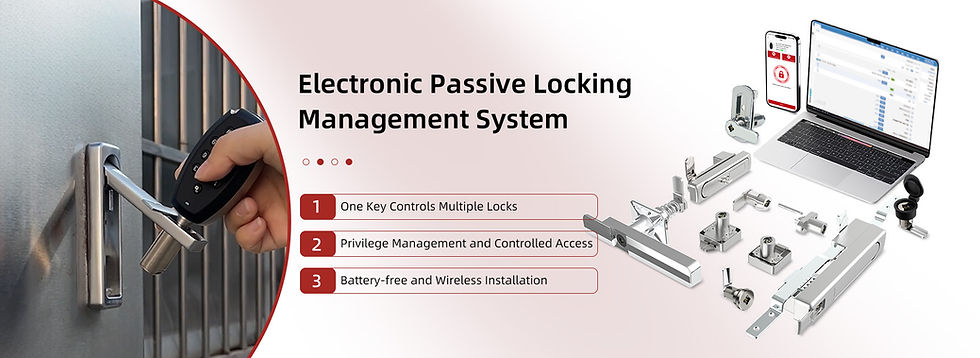
There is a better way. At Kerongtech, our passive lock technology solves this problem with an elegant answer: a single electronic key can manage up to 10,000 passive locks — no batteries in the lock, no wiring, no compromise on security.
What Is a Passive Lock?
A passive lock is an electromechanical lock with no internal power source. Instead, the electronic key supplies the energy and intelligence needed for every operation. When the key is inserted, it authenticates itself, verifies the user's permissions, and releases the locking mechanism — all in a fraction of a second.
Because the lock itself needs no battery, no wiring, and no ongoing power supply, it can be deployed almost anywhere:
Outdoor utility cabinets and substations, where running cables is impractical
Telecom base stations and fiber distribution points in remote locations
Logistics and warehousing, with hundreds of access points across large facilities
Rail, transport infrastructure, and industrial plants exposed to harsh environments
The Real Power: Unmatched Management Capability
The headline feature — one electronic key managing up to 10,000 locks — is more than a number. It fundamentally changes how organizations think about access control.
Centralized Control at Scale Imagine a utility company with 10,000 cabinets spread across an entire region. With Kerongtech's passive lock system, every one of those locks can be enrolled, grouped, and managed from a single software platform. Access rights are defined centrally and delivered to the key — not drilled into thousands of individual locks.
Granular, Flexible Authorization
Not everyone needs access to everything. Permissions can be configured per user, per lock group, and per time window. A contractor working on a specific substation can be granted access to exactly the locks they need — and only during their working hours. When the job is done, permissions are revoked instantly with a single software update.
Full Audit Trail, Zero Blind Spots
Every operation is recorded: who opened which lock, and when. This transforms compliance and accountability. Instead of wondering whether a cabinet was accessed after hours, administrators can see the complete history — a capability that mechanical keys simply cannot offer.
Lower Total Cost of Ownership
With no batteries to replace across 10,000 locks, no wiring to install, and no complex networked infrastructure, passive locks dramatically reduce maintenance and deployment costs. The electronic key does the heavy lifting; the locks just work — for years, in any environment.
From Lock-and-Key to Smart Access Ecosystem
The passive lock isn't just a replacement for the humble padlock. Combined with Kerongtech's management software, it becomes part of a connected access ecosystem:
Blacklist lost keys instantly — without rekeying a single lock
Rotate access schedules for seasonal or shift-based workforces
Scale without limits — add new locks to the system in minutes, not days
Integrate with existing workflows through centralized administration
Security at scale shouldn't mean complexity at scale. Kerongtech's passive lock system proves that one electronic key — managing up to 10,000 passive locks — can deliver enterprise-grade access control with the simplicity of a traditional key.
No batteries. No wiring. No limits.
Discover how Kerongtech can secure your assets at any scale. Contact us today for a consultation.


Comments