
What is a Rotary Latch?

Picture a parcel locker door that gets opened and slammed shut dozens of times a day by different couriers and customers, a vending machine panel that takes constant knocks from restocking carts, or a shared storage locker in a busy building lobby. In every one of these cases, a simple hook or hasp latch just isn't enough — repeated slamming, impact, and everyday wear can work it loose over time. This is exactly the problem rotary latches were designed to solve, and it's why they've quietly become the go-to mechanism in high-traffic, self-service equipment where a door absolutely cannot pop open on its own.
If you're designing a parcel locker, storage locker, vending machine, or similar self-service equipment and trying to figure out whether a rotary latch is the right hardware for the job, this post covers what a rotary latch actually is, how it differs from a standard latch, and what to look for when sourcing one — along with where KERONG fits into that picture.
The Basic Definition
A rotary latch is a mechanical fastening device that uses a rotating cam or "fork bolt" to capture and hold a striker pin or bolt in place. Instead of a hook simply resting against a keeper (as in a standard latch), the rotary latch's rotating mechanism wraps around the striker and locks it in a captured, load-bearing position, giving it a much firmer, more secure hold than a simple hook ever could.
That rotating, self-capturing action is the key difference from a simple latch or hasp, and it's what gives rotary latches their signature strength: resistance to vibration, shock, and unintentional release.
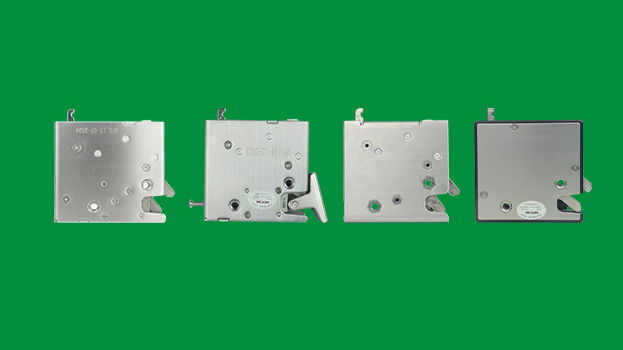
How a Rotary Latch Works
The mechanics are straightforward once you see them in action:
The door or panel closes, pushing a striker pin or bolt into the rotary latch's fork-shaped rotor.
The rotor spins, capturing the striker inside its curved profile rather than just resting against it.
A spring-loaded pawl locks the rotor in place, preventing it from spinning back open under vibration, shock, or accidental pressure.
To open, the pawl is released — via signal— allowing the rotor to spin free and release the striker.
Many rotary latches also include a two-stage catch: a "secondary" or "safety" position that holds the door slightly ajar if it isn't fully closed, and a "primary" fully-latched position. This two-stage design is a deliberate safety and quality-control feature — it prevents a locker or cabinet door from appearing closed when it isn't fully secured, which matters a great deal when a locker is holding someone's package or belongings.
Why Rotary Latches Exist: What They Solve
Standard hook latches and simple slide bolts work fine in low-traffic, low-impact settings. But they start to fail in a few very specific — and very common — situations:
High-frequency daily use (parcel lockers and vending machines opened and closed dozens or hundreds of times a day by different users)
Repeated slamming or careless handling (courier drop-offs, restocking, impatient users pushing doors shut quickly)
High-security or unattended closures where an accidental release is a real hazard — a parcel locker door popping open on its own means a lost or stolen package, not just an inconvenience
Environments requiring a sealed, weatherproof closure, since the capturing action of a rotary latch also helps compress gaskets evenly around a door or panel, useful for outdoor lockers and vending units
In all of these cases, a rotary latch's self-capturing, load-bearing design holds up where a simple hook or hasp would eventually rattle loose.
Where Rotary Latches Are Used
Once you know what to look for, rotary latches show up constantly in self-service and unattended equipment:
Parcel and delivery lockers — the individual compartment doors couriers and customers open throughout the day
Smart storage lockers — shared lockers in offices, apartment buildings, gyms, and co-working spaces
Vending and micro-fulfillment machines — compartment doors and access panels opened frequently during restocking and dispensing
Retail and self-checkout equipment — secure compartments and cash/asset drawers
Shared equipment and tool cabinets — lockers holding tools, devices, or shared assets in workplace or industrial settings

The common thread across all of these: a door or compartment that gets opened constantly by different, often careless users, and needs to stay reliably and securely closed every single time without gradually working itself loose. What to Look for in a Quality Rotary Latch
If you're specifying rotary latches for a product or installation, a few factors separate reliable hardware from latches that fail early:
Cycle life appropriate for high-frequency use, since parcel lockers and vending machines may be opened far more often than a typical cabinet
Material and corrosion resistance, especially for outdoor parcel lockers and vending units exposed to weather and temperature swings
Two-stage catch availability, for applications where a "door ajar" safety warning matters — critical for lockers holding valuable packages
Manufacturing consistency, since rotary latches are usually deployed across dozens or hundreds of identical compartment doors on the same bank of lockers or vending units
Where KERONG Fits In
KERONG manufactures lock and latch hardware for lockers, cabinets, and self-service equipment, and rotary latches are part of that broader focus on hardware that has to perform reliably in high-traffic, unattended environments — not just sit quietly on a display shelf. KERONG's rotary latches are used primarily in parcel and delivery lockers, smart storage lockers, and vending and self-service machines, where a compartment door is opened by a different user many times a day and simply cannot afford to work loose or fail to catch.
A few things shape KERONG's approach to rotary latch design and production:
Application-specific configurations, with options suited to the load and actuation requirements of parcel lockers, storage lockers, and vending equipment rather than a single one-size-fits-all part
Attention to two-stage safety catch design, so a compartment door can flag as "not fully closed" rather than appearing shut when it isn't — important when the compartment is holding someone's package or belongings
Corrosion-resistant materials and finishes, built for outdoor parcel lockers and vending units exposed to weather and temperature swings
Compatibility with multiple actuation methods, including manual handles, key cylinders, and remote or electric release tied into RFID readers or app-based access systems, so the latch integrates cleanly with the control systems already used in smart lockers and vending equipment
Manufacturing consistency at scale, since rotary latches are typically ordered in volume for full banks of lockers or entire vending machine product lines rather than as one-off parts
For teams designing parcel lockers, smart storage lockers, or vending and self-service equipment that need to stay reliably closed under constant daily handling, working with a manufacturer that treats latch selection as an engineering decision — not an afterthought — makes a measurable difference over the life of the product.
Working on a project that needs rotary latches for parcel lockers, storage lockers, or vending equipment? Reach out to KERONG to discuss load requirements, actuation options, and bulk manufacturing for your application.


Comments