
Battery-Free Smart Lock: The Best Way to Avoid Dead Locks

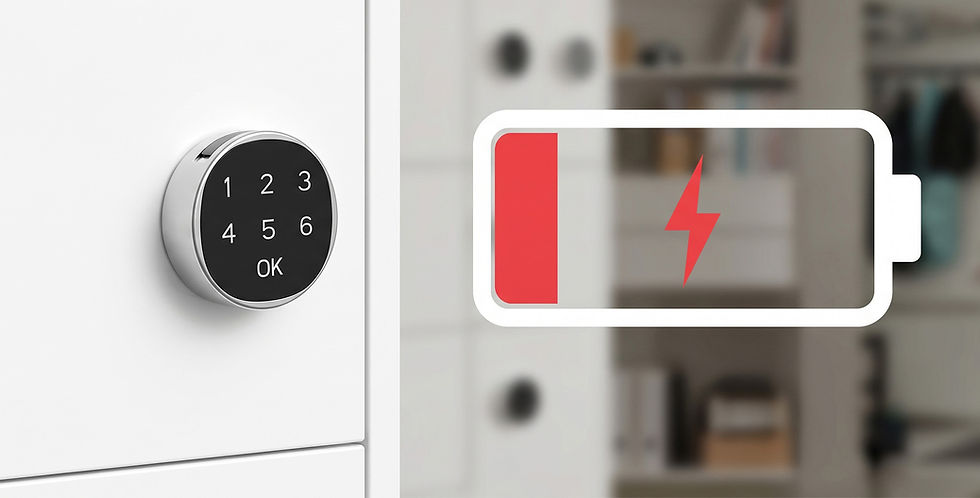
Nothing ruins your day quite like a dead smart lock. You come home with your hands full of groceries, tap your phone, and... nothing. The battery died overnight. You're locked out — and this is supposed to be the "smart" option?
If you've ever owned a battery-powered smart lock, you know the routine. Check the app for battery levels. Wonder whether this month's the month it finally gives out. Keep spare AA batteries in the junk drawer "just in case." And when it does die — usually at the worst possible moment — you're scrambling for a backup key, a 9V battery trick, or a locksmith's phone number.
There's a better way. Battery-free smart locks eliminate the single biggest weakness of traditional smart locks: the battery itself.

What Is a Battery-Free Smart Lock?
A battery-free smart lock doesn't carry any internal battery at all. Instead, it harvests the small amount of energy it needs at the moment of unlocking — typically from your smartphone's NFC field, or from the kinetic motion of inserting and turning a key or handle.
With KERONG's battery-free locking solutions, your phone acts as both the key and the power source. A quick tap of your NFC-enabled smartphone delivers a secure, encrypted authentication signal and just enough energy to drive the lock mechanism. The lock wakes up, verifies you, and opens — using less than 1% of your phone's battery charge, roughly the equivalent of sending a text message.
When the interaction is over, the lock simply powers down again. No standby drain. No charging. No batteries, ever.
The Hidden Costs of Battery-Powered Smart Locks
Battery-powered locks look convenient on paper, but the reality includes a long list of hidden costs and frustrations:
Battery anxiety. Most battery locks last 6–12 months on a set of batteries. That's a ticking clock you're always aware of — and one you will eventually forget about.
Unexpected lockouts. Low-battery warnings are easy to miss, and failures always seem to happen on holidays, late at night, or while you're traveling.
Recurring battery costs. Multiply a few dollars per lock by dozens or hundreds of locks across an office, gym, hospital, or locker facility, and the annual bill adds up fast.
Maintenance labor. Someone has to physically check, replace, and dispose of batteries on a rolling schedule — a full-time headache for facility managers.
Battery damage. Leaking or corroding batteries can damage the lock body and electronics, shortening the product's lifespan.
E-waste. Millions of dead batteries end up in landfills every year from smart devices alone.
With a battery-free lock, every single one of these problems simply disappears.
The Real Advantages of Going Battery-Free
1. Never worry about charging — or dying — again
There's no battery to charge, and no battery to die. The lock draws power only when you use it, from a source (your phone) that you already carry and recharge every day. You'll never ask "when will the battery run out?" because there is no battery to run out.
2. Truly maintenance-free
No scheduled battery inspections. No replacement cycles. No technician visits. Install the lock, and it works — today, next year, and years after that. For businesses managing hundreds of lockers, cabinets, or doors, this translates into dramatically lower total cost of ownership.
3. Lower lifetime costs
While a battery-powered lock keeps consuming batteries for its entire life, a battery-free lock's operating cost after installation is essentially zero. Over 5–10 years of service, the savings on batteries and maintenance labor often exceed the initial price difference many times over.
4. Better for the planet
No batteries means no battery waste, no toxic disposal, and a smaller carbon footprint. For organizations with sustainability goals, battery-free locking is an easy, visible win.
5. Security that never sleeps
Battery-free locks like KERONG's use secure NFC communication with encrypted authentication, so access can't be spoofed or replayed. And because there's no battery or standby circuitry inside, there's nothing to leak, short-circuit, or silently drain — the lock is physically incapable of dying on you.
6. Easy installation
With no wiring and no battery compartments, battery-free locks install just like a standard mechanical lock. KERONG's passive electronic locks are compatible with conventional lock holes and can replace existing locks in minutes — no drilling, no electrical work, no disruption to your space.
Where Battery-Free Locks Shine
Office cabinets, drawers, and file storage — secure access without IT maintenance
Gyms, spas, and leisure centers — no more locker lockouts for members or staff
Hospitals and healthcare facilities — reliable, hygienic, maintenance-free security
Schools and universities — student lockers that never fail during exam season
Parcel lockers and smart lockers — high-traffic environments where battery maintenance would be a logistical nightmare
Outdoor and industrial cabinets — weatherproof options that withstand harsh environments
The Bottom Line
Smart locks were supposed to make our lives easier. But a lock that depends on a battery you must constantly monitor, replace, and pay for isn't truly smart — it's just a mechanical lock with extra steps.
A battery-free smart lock removes the weakest link. No charging. No battery anxiety. No maintenance schedules. No emergency lockouts. Just reliable, secure access every single time — powered by the phone already in your pocket.
Once you've used a lock that can never die, you'll wonder why anyone still puts up with batteries.
Ready to say goodbye to dead batteries forever? Explore KERONG's range of battery-free smart locking solutions — from NFC cabinet locks to passive electronic cylinders — and find the right fit for your home, office, or facility.


Comments